Independent story / H-20d / English working copy
Just KUK
A story behind Glesbygdens kollaps — Paul Bogatir's recollection
Related recording: Glesbygdens kollaps →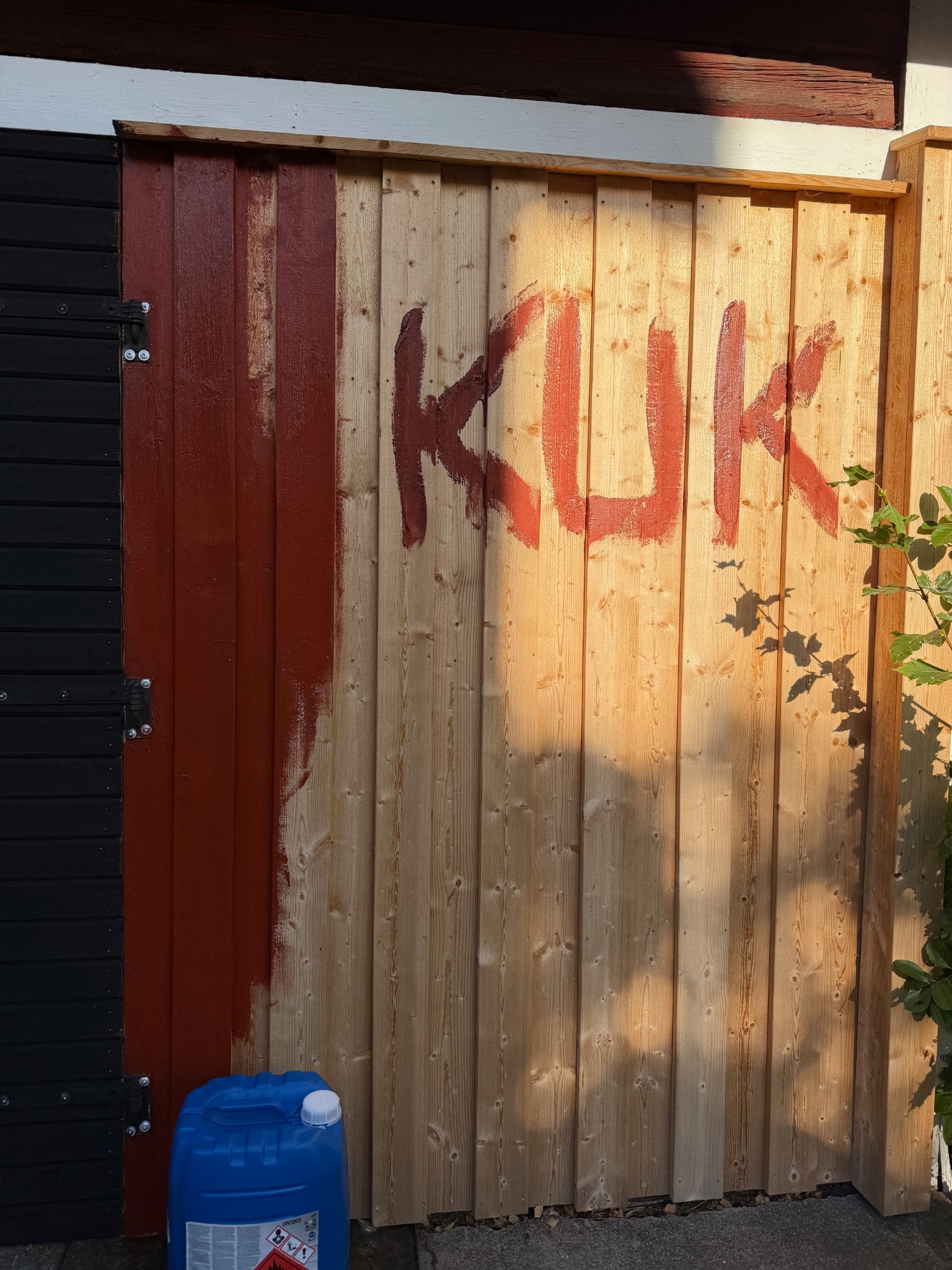
Once upon a time, there were three cousins.
One was cutting the grass with a ride-on lawnmower. Another was using an ordinary push mower. And the third was painting a wall for their aunt.
I was the one painting the wall, using traditional Swedish Falu red paint.
When I looked away, the cousin with the ride-on mower had painted KUK on the wall. He then took a photograph and sent it to my father with the message:
“Look what Paul has done!”
This particular cousin also owns a Saab 96, which appears in Wrong Pig. That is another story.
I painted over the word.
But while I was painting, I started thinking about it.
Boys have been writing KUK on walls for as long as I can remember. It means cock in Swedish. What a peculiar thing to write.
At Möljen in Hudiksvall, there is an old neon sign from the 1950s that simply says KORV.
Sausage.
Not Good sausage. Not Buy sausage. Just KORV.
At least they could have added an exclamation mark, so that it might have sounded like an instruction.
But no. Just KORV.
And here was KUK.
I began wondering whether writing KUK on walls might be a particularly rural tradition.
I thought about Vikings and all those phallic figures. Perhaps there is something rather beautiful about writing KUK after all. A kind of punk tradition handed down through the centuries.
And then I started thinking about the Swedish countryside.
I believe rural Sweden has been an extraordinarily important breeding ground for eccentric culture and the kind of popular education that is passed on through conversation, storytelling and people spending time together.
And I think much of it is disappearing because our politicians don't give a shit about it.
I think that's important to say.
If rural Sweden collapses, we lose something fundamental in our cultural heritage.
All those characters who don't quite fit into the big cities risk disappearing into obscurity.
What's left are the people who have been pushed aside and the people who have learned to conform.
For a long time, the countryside offered something in between.
A place where you could be yourself without having to be filthy rich.